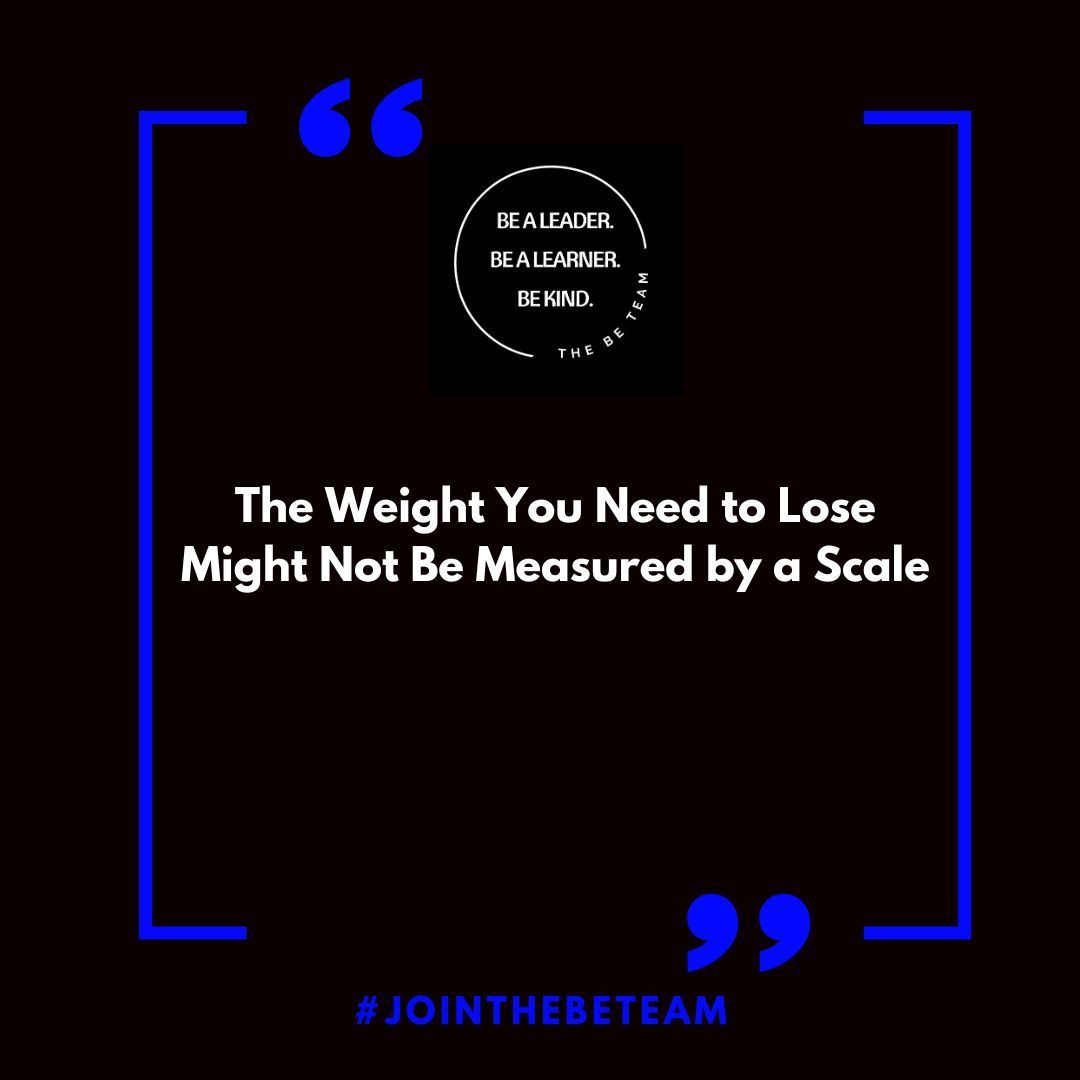
The Weight You Need to Lose Might Not Be Measured by a Scale
August 26, 2024

When we think about losing weight, we usually picture diet plans, workouts, and the number on a scale. But the most important weight we carry isn't always physical. Often, it's the emotional and mental burdens that weigh us down, keeping us from feeling truly happy and healthy.


The Hidden Burdens We Carry


Stress, anxiety, self-doubt, and negative thoughts—these are just a few examples of the invisible weights many of us carry every day. Unlike physical weight, these burdens are harder to see but can be just as harmful to our well-being.


Maybe you're holding onto past mistakes, unresolved conflicts, or the expectations others have of you. These emotional loads can drain your energy and make you feel stuck. But just like with physical weight, these burdens can be lightened. The first step is recognizing them and deciding to let them go.


Three Questions to Ask Yourself


1. What am I holding onto that’s weighing me down?

Think about the emotional baggage you might be carrying. 

Are there past failures you can’t let go of? 

Are certain relationships more draining than supportive? 

Identifying these burdens is the first step to letting them go.


2. How do I talk to myself?

The way we talk to ourselves can either lift us up or drag us down. 

Are you often too hard on yourself? 

If so, start paying attention to your thoughts and try to replace negative ones with kinder, more positive words.


3. Am I taking care of my emotional and mental health?

Life gets busy, and it’s easy to neglect our mental health. 

Ask yourself if you’re giving enough attention to your emotional needs. 

Are you setting boundaries, practicing self-care, and making time for things that bring you joy and peace?


Two Quotes to Keep You Motivated

- “The heaviest weight we carry is the burden of our own expectations." — Unknown

- "Sometimes, you have to let go simply because it's too heavy to hold onto." — C. JoyBell C.


One Action Item: Start Letting Go

This week, pick one thing that’s been weighing you down emotionally or mentally and commit to letting it go. It could be forgiving yourself for something in the past, taking a step back from a toxic relationship, or changing a negative thought pattern. Write it down and take small steps to release this burden from your life.


Becoming the best version of yourself isn’t just about losing physical weight. It’s about finding balance, peace, and clarity in every part of your life. By letting go of the emotional and mental burdens that hold you back, you’ll feel lighter, freer, and more ready to live the life you truly want.


So remember: the weight you need to lose might not be measured by a scale, but letting it go can make a huge difference in how you feel.


Until we meet again: Be a Leader. Be a Learner. Be Kind.


Dr. Roy Bishop, Jr.


Ready to take your leadership skills to the next level? Click Here to sign up for a complimentary 1-hour leadership consultation with me today! Let's work together to equip you with everything you need to achieve greatness! 


Check out our website at www.jointhebeteam.com for more tips, tools, and resources for leaders! 


share this

Related Articles
By Roy Bishop November 26, 2025
1 Truth · 2 Strategies · 1 Reflection Weekly Leadership Lift with Dr. Roy Bishop, Jr. If you want to avoid burnout, start your day with yourself before you give it away to everyone else. Most educational leaders wake up and immediately jump into emails, messages, or mental checklists of what needs to get done. Before the day even begins, you’re already reacting instead of leading. And when every day starts like that, burnout isn’t a possibility; it’s a guarantee. You can’t lead others well if you don’t lead your own morning first. 1 Truth The tone of your morning sets the temperature for your leadership. When you wake up rushing, your day stays rushed. When you wake up grounded, your day follows your rhythm, not everyone else’s. The best leaders don’t wait for peace to find them; they create it. That’s why every morning should begin with intentional stillness, a quiet moment to connect with yourself before the demands of the day take over. Whether it’s reflection, working out, journaling, or silence, those first minutes shape how you think, decide, and show up for others. 2 Strategies to Live It Out 1. Create a “No Noise” Zone (I have to do this in my car sometimes…) Spend your first 15–20 minutes without screens, texts, or social media. Instead, check in with your mindset. Ask yourself: What do I need to feel centered today? Maybe it’s gratitude, calm, or focus. When you take control of your internal environment, you can handle anything that happens in your external one. 2. Set an Intention, Not Just a Schedule. Before you dive into your calendar, decide how you want to be today, not just what you want to do. For example: “Today I will lead with patience.” “Today I will listen more than I speak.” This simple shift helps you lead from clarity instead of chaos. 1 Reflection Question What’s the first thing you focus on each morning and how does it impact the rest of your day? Take Action Tomorrow morning, try this: wake up 15 minutes earlier. Don’t check your phone. Don’t open your email. Just sit with your thoughts, breathe, stretch, or write. Give yourself the first and best part of your day. That single act of discipline will protect your energy more than any time-management strategy ever could. Final Word Avoiding burnout doesn’t require a total life overhaul, it requires a consistent commitment to start your day on purpose. You can’t pour into others if you’re already empty when the day begins. Lead your morning, and you’ll lead your mindset. Lead your mindset, and you’ll lead your day. Lead your day, and you’ll lead your life. Until next time, Be a Leader. Be a Learner. Be Kind. Let’s keep leading together. Dr. Roy Bishop, Jr. Founder of The Be Team I help leaders and future leaders, from the classroom to the boardroom, build confidence, protect their peace, and grow into the best version of themselves by learning to grow through the seasons of feeling stuck, burnt out, or overlooked. It happens to all of us at some point so why not prepare for it? Because leadership isn’t about titles; it’s about becoming. And I believe that everyone, no matter their age or experience, deserves the chance to be the leader they were meant to be.
By Roy Bishop October 22, 2025
1 Truth · 2 Strategies · 1 Reflection Somewhere along the way, I started confusing being busy with being effective. I’ve always been told that working longer hours and sacrificing rest somehow proves our dedication. But being exhausted isn’t a sign that you’re doing great work. It’s a sign that you’re doing too much of the wrong work (there is such a thing), the kind that drains your purpose instead of fueling it. As educational leaders, we pour into everyone else, students, staff, and families and often forget to pour back into ourselves. Leadership isn’t about doing it all. It’s about doing what matters most, with energy, clarity, and intention. You can’t lead effectively if you’re constantly running on fumes (I have never seen this done well). 1 Truth You’re not tired because you’re weak. You’re tired because you’re operating without renewal. When you ignore rest, reflection, and boundaries, you trade long-term effectiveness for short-term validation. Exhaustion might look like dedication, but it’s really depletion. Strong leaders understand that protecting their energy isn’t selfish, it’s smart. The best version of you isn’t the busiest one. It’s the one that’s focused, fueled, and fully present for your team, your students, and yourself (we often forget about ourselves in the equation). 2 Strategies to Live It Out Audit Your Energy Before the week gets away from you, take a few minutes to ask yourself: What gives me energy? What drains it? Then make one small adjustment. Maybe it’s saying no to an extra meeting, taking a short walk instead of scrolling your phone, or turning off notifications after hours. Awareness creates alignment, and alignment builds sustainability. Rest Without Guilt Rest is not a reward for getting everything done. It’s a requirement for showing up as your best self. Schedule your recovery time like any other meeting (seriously, put it on your calendar now or it won’t happen). Sleep, quiet reflection, and personal time don’t make you soft. They make you last. The leaders who thrive long-term are the ones who protect their peace and model balance for others (I used to be really bad at this). 1 Reflection Question What is one responsibility or mindset I’ve been holding onto that no longer deserves my energy? Take Action Take ten minutes today to define your energy boundaries. Write down three things that drain you and three things that refuel you. Keep that list somewhere visible. Every time you start to feel overwhelmed, go back to it. Your energy is your leadership advantage so protect it. Final Word Exhaustion is not a requirement of leadership; it’s a signal that something needs to change. You don’t have to prove your worth by overworking yourself. You prove it by showing up whole, grounded, and consistent. When you protect your peace, you amplify your presence. When you slow down, you gain clarity. When you take care of yourself, you give everyone around you permission to do the same. Until next time, Be a Leader. Be a Learner. Be Kind. Let’s keep leading together. Dr. Roy Bishop, Jr. Founder of The Be Team — helping educational leaders lead with purpose, balance, and mindset. I help leaders and future leaders from the classroom to the boardroom, build confidence, protect their peace, and grow into the best version of themselves by learning to grow through the seasons of feeling stuck, burnt out, or overlooked. It happens to all of us at some point, so why not prepare for it? Because leadership isn’t about titles; it’s about becoming. And I believe that everyone, no matter their age or experience, deserves the chance to be the leader they were meant to be.
By Roy Bishop October 22, 2025
1 Truth · 2 Strategies · 1 Reflection Somewhere along the way, I started confusing being busy with being effective. I’ve always been told that working longer hours and sacrificing rest somehow proves our dedication. But being exhausted isn’t a sign that you’re doing great work. It’s a sign that you’re doing too much of the wrong work (there is such a thing), the kind that drains your purpose instead of fueling it. As educational leaders, we pour into everyone else, students, staff, and families and often forget to pour back into ourselves. Leadership isn’t about doing it all. It’s about doing what matters most, with energy, clarity, and intention. You can’t lead effectively if you’re constantly running on fumes (I have never seen this done well). 1 Truth You’re not tired because you’re weak. You’re tired because you’re operating without renewal. When you ignore rest, reflection, and boundaries, you trade long-term effectiveness for short-term validation. Exhaustion might look like dedication, but it’s really depletion. Strong leaders understand that protecting their energy isn’t selfish, it’s smart. The best version of you isn’t the busiest one. It’s the one that’s focused, fueled, and fully present for your team, your students, and yourself (we often forget about ourselves in the equation). 2 Strategies to Live It Out 1. Audit Your Energy Before the week gets away from you, take a few minutes to ask yourself: What gives me energy? What drains it? Then make one small adjustment. Maybe it’s saying no to an extra meeting, taking a short walk instead of scrolling your phone, or turning off notifications after hours. Awareness creates alignment, and alignment builds sustainability. 2. Rest Without Guilt Rest is not a reward for getting everything done. It’s a requirement for showing up as your best self. Schedule your recovery time like any other meeting (seriously, put it on your calendar now or it won’t happen). Sleep, quiet reflection, and personal time don’t make you soft. They make you last. The leaders who thrive long-term are the ones who protect their peace and model balance for others (I used to be really bad at this). 1 Reflection Question What is one responsibility or mindset I’ve been holding onto that no longer deserves my energy? Take Action Take ten minutes today to define your energy boundaries. Write down three things that drain you and three things that refuel you. Keep that list somewhere visible. Every time you start to feel overwhelmed, go back to it. Your energy is your leadership advantage so protect it. Final Word Exhaustion is not a requirement of leadership; it’s a signal that something needs to change. You don’t have to prove your worth by overworking yourself. You prove it by showing up whole, grounded, and consistent. When you protect your peace, you amplify your presence. When you slow down, you gain clarity. When you take care of yourself, you give everyone around you permission to do the same. Until next time, Be a Leader. Be a Learner. Be Kind. Let’s keep leading together. Dr. Roy Bishop, Jr. Founder of The Be Team — helping educational leaders lead with purpose, balance, and mindset. I help leaders and future leaders from the classroom to the boardroom, build confidence, protect their peace, and grow into the best version of themselves by learning to grow through the seasons of feeling stuck, burnt out, or overlooked. It happens to all of us at some point, so why not prepare for it? Because leadership isn’t about titles; it’s about becoming. And I believe that everyone, no matter their age or experience, deserves the chance to be the leader they were meant to be.
More Posts
ALL ARTICLES

STAY UP TO DATE

the latest from the be team

Receive an alert anytime a new post drops

Contact Us
A white background with a few lines on it